...
- Byte mode - allows working with devices that implement the registers as 1-byte variables (in contrast with Modbus standard in which the register value is 2 bytes).
- Variable mode - allows working with devices that implement the registers with different sizes than standard 2 bytes. It was implemented because of support of the flowmeter FloBoss 103 made by Fisher Controls International (at this time a part of Emerson Process Management): 1-byte variables, 4-byte unsigned/signed integers, text strings of length 10,12,20,40 characters, a 6-byte time stamp, and other.
Note: this mode enables work with devices implementing the so-called Enron Modbus or Daniel Modbus. - Passive (scanning) mode allows to work in eavesdropping mode. This applies especially to serial communication when the communication port of the device is already used to communicate with another Master device. Due to the nature of the Modbus protocol, it is necessary to receive both requests and responses in this mode.
...
- Line category Serial (serial communication)
- Line category SerialOverUDP Device Redundant (serial communication).
- Line category RFC2217 Client (serial communication).
- Line category TCP/IP-TCP and TCP/IP-TCP Redundant (MODBUS over TCP/IP). Reserved TCP port 502 is commonly used, but it is possible to use any other one according to the setting of the device. The line number is not used, ; set the value, e.g. to 1.
Note: For redundant systems, it is possible to enter multiple names/addresses separated by commas.
Note: In the case of WAGO 750-8100 type PLC and communication via MODBUS TCP, it was necessary to set a small polling period (e.g. 1 second) in the time parameters of the station. In the case of a longer period (5 seconds), the connection was closed quite often by the PLC.
...
| Kotva | ||||
|---|---|---|---|---|
|
...
A dialog dialogue window of of communication line configuration - Protocol parameters tab.
They influence some optional protocol parameters.
...
- Communication protocol "Modbus Client".
- The station address is a decimal number mostly in the range of 1 up to 247. Address 0 is reserved as broadcast.
Note: If no I/O tag with a valid address is configured on the station, no communication will take place, and the station will be in an error state (StHARDERR).
Station protocol parameters
Configuration dialog dialogue box - tab Parameter.
They influence some optional parameters of the protocol. The following station protocol parameters can be set:
...
| Parameter | Meaning | Unit | Default value | ||||||
|---|---|---|---|---|---|---|---|---|---|
| Maximum count of request retries. If no response returns is returned after a request has been sent, the station's status will change to a communication error. | - | 2 | ||||||
| Timeout before resending a request if no response has been received. | s | 0.1 | ||||||
| The delay after sending the request and before reading the response. | s | 0.1 | ||||||
| The delay between the response readings. | s | 0.1 | ||||||
| The maximum number of retries of for the response reading. | - | 20 | ||||||
| "Start silent interval" before the beginning of the transmission in RTU mode. | ms | 50 | ||||||
| "Stop silent interval" after ending the end of the transmission in RTU mode. | ms | 50 | ||||||
| After writing to the I/O tag, the reading immediately follows. By setting the parameter to the NO value, it is possible to reduce the load on communications (especially serial ones) with a large number of writes. | YES/NO | YES | ||||||
| Byte order in Little-endian mode for 4-byte variables. The individual options indicate in which bytes (1-lowest, 4-highest) the individual bytes from the communication will go:
| - | 2143 | ||||||
| Special byte mode of transmission in which the values of registers have a length of 1 byte and not 2 bytes, as it is defined in the Modbus protocol specification. | YES/NO | NO | ||||||
| Special variable mode of transmission in which the values of registers have variable lengths. The setting of Variable mode: Note 1: Variable and byte modes are incompatible, and only one of them can be enabled. | OFF Little endian Big endian | OFF | ||||||
| Logging of detailed debug information about communication in the line log. | YES/NO | NO | ||||||
| Protocol mode: RTU or ASCII. Note: In the case of "MODBUS over TCP/IP", the parameter value is ignored, and Protocol Mode=RTU is used. | RTU ASCII | RTU | ||||||
| Sets an address model of the MODBUS protocol: MODBUS PDU data are addressed from 0 up to 65535. MODBUS data Model data are addressed from 1 up to 65536. Note: MODBUS PDU is a default value. If the MODBUS data Model is set, the object with the address X is addressed as X-1 in the MODBUS PDU. After you change this parameter, a restart of the respective communication process was required in the past (KOM binaries older than May 27, 2021). | MODBUS PDU MODBUS data Model | MODBUS PDU | ||||||
| Select a variant of the protocol in case of TCP/IP communication: "MODBUS TCP" is a variant of communication without a control checksum. Safeguarding is done by the underlying TCP protocol. "MODBUS over TCP" is a variant where a payload is MODBUS RTU data containing a checksum. | "MODBUS TCP" "MODBUS over TCP" | "MODBUS TCP" | ||||||
| Maximum The maximum count of registers that are read by one request. | - | 100 | ||||||
| Maximum The maximum count of bytes that are required by required by one request (only in "Byte mode"). | - | 100 | ||||||
| If a value of the integer type (Holding Registers, Input Registers) is assigned to an I/O tag of the Di or Dout type, this is done by comparing the read value with zero. If the value is zero, the value of the I/O tag is False, otherwise True. The Bool Mask parameter allows specific bits to be filtered out before the comparison is made, based on a bitmask specified as a hexadecimal number (the leftmost byte is the highest). The bitmask FF FF FF FF means that all bits are considered (for 1- and 2-register integer addresses). | - | FF FF FF FF | ||||||
| This parameter is used to avoid reading the values from addresses that are not configured. Description and example: | YES/NO | NO | ||||||
| If this parameter is set to YES, then an extra check is performed when receiving a response to a read request: the length of received data is checked to see whether it matches the number of registers in a read request:.
| YES/NO | NO | ||||||
| If the parameter is set to YES, then a single request (which contains the total number of registers) is used. It is necessary that the I/O tags are defined for all addresses 0..N. | YES/NO | NO | ||||||
| On the TCP/IP-TCP line, immediately after the connection is established, it is possible to write a specific value to the selected address (TCP Password Address) using the selected function (TCP Password Function). In this way, the ComAp control unit enables the authorized authorised Modbus client to be authenticated. The value is entered in hexadecimal in the order of the bytes as they will be transmitted (e.g. "01 0A BC D0". If an odd number of bytes is entered, a byte with the value 0 will be added at the end. Setting the parameter to an empty value causes the write to not be performed after the connection is established. | - | |||||||
| Address for writing the password (TCP Write Password) on the TCP/IP-TCP line. If the password is longer than 2 bytes, it is the address of the first register. If the password has e.g. 6 bytes, written as 3 registers from the specified address. | - | 0 | ||||||
| The write function for writing the password (TCP Write Password) on the TCP/IP-TCP line. | 6 16 | 6 |
...
The main address space in the protocol MODBUS is divided into the following registers:
- Coils Coil type (reading/writing)
- Discrete Inputs (reading)
- Holding Registers (reading/writing)
- Input Registers (reading)
Independent addressing with the address size of 2 bytes, i.e. addresses from 0 up to 65535 (so-called MODBUS PDU addressing model), is in an address space of each type of register. Some devices work with an address space starting with 1 (so-called called MODBUS Data Model). In this case, it is necessary to deduct 1 in the address at configuration I/O tags in the D2000 system or change the setting of the parameter Addressing model to the MODBUS data Model.
...
| Kotva | ||||
|---|---|---|---|---|
|
Address format is [I|U|Uu|Ul|f|F|L|Ll|S|Sl|B|X|sn.|an.|An.][d|D][b][s]RdFn[-WrFn[d|r]].Address[.BitNr] [,Items] in which:
- The first character defines a type of I/O tag:
- I - Integer16 (default) - one register is read, signed
- U - Unsigned16 - one register is read, unsigned
- Uu - Unsigned16 - one register is read, unsigned, and only the upper byte is processed (1st in sequence)
- Ul - Unsigned16 - one register is read, unsigned, and only the lower byte is processed (2nd in sequence)
- f - Float (4 bytes = 2 registers) - two registers with Address and Address+1 are read and transmitted as big-endian (see Note).
- F - Float (4 bytes = 2 registers) - two registers with Address and Address+1 are read and transmitted as little-endian (so-called Modicon format), (see Note)
- L - Unsigned long (4 bytes = 2 registers) - two registers with Address and Address+1 are read, unsigned, and transmitted as big-endian (see Note)
- Ll - Unsigned long (4 bytes = 2 registers) - two registers with Address and Address+1 are read and transmitted as little-endian, unsigned (see Note)
- S - Signed long (4 bytes = 2 registers) - two registers with Address and Address+1 are read, signed, and transmitted as big-endian (see Note)
- Sl - Signed long (4 bytes = 2 registers) - two registers with Address and Address+1 are read and transmitted as little-endian, signed (see Note)
- B - Byte unsigned, only the upper 8 bits of the register value
- X - Byte unsigned, only the lower 8 bits of the register value
- sn. - Text string with the length of n characters, one register is one character, n registers with Address up to Address+n-1 are read
- an. - Text string with the length of 2*n characters, one register is two ASCII characters, characters are transmitted in the same order as they appear in the string, n registers with Address up to Address+n-1 are read
- An. - Text string with the length of 2*n characters, one register is two ASCII characters, characters are transmitted in big-endian order (i.e. "1234" is transmitted as "2143"), n registers with Address up to Address+n-1 are read
- Modifier d indicates that a number is an 8-byte number (4 consecutive registers). It can be used for types L, Ll, S, Sl, F,f, and it is used for configuration of signed/unsigned 8-byte integer as well as an 8-byte float (big-endian <B8>..<B1> and little-endian <B1>..<B8> formats).
Modifier D indicates that a number is an 8-byte number (4 consecutive registers). It can be used for types Ll, Sl, F, and it is used for the configuration of signed/unsigned 8-byte integer as well as an 8-byte float (little-endian format <B2><B1><B4><B3><B6><B5><B8><B7>). - Modifier b indicates that the number is BCD-coded. It can be used for I/O tags of of I, U, B, L, Ll types.
Modifier s indicates that a status register (Unsigned16) located on address Address is followed by a big-endian Float value located on address Address+1 .. Address+2. This indicator is used for type f and it is implemented for calorimeter Endress+Hauser RMS621. The following table shows the values of the status register and their mapping to D2000 attributes.
Status register D2000 attributes 0: Invalid value Weak 1: Measured value valid Valid 2: Overflow warning
3: Overflow error
4: Underflow warning
5: Underflow error
6: Saturated steam alarm
7: Error in differential pressure calculation
8: Wrong medium for DP calculation
9: Wrong value range - DP calculation inaccurate
10: Differential pressure - general error
11: Range overshoot (Tsat > 350 etc.) on
12: Change in state of aggregation
26: Differential pressure --> general error
99: No measured value is assigned to the register in the setup of the ModBusWeak - Parameter RdFn is a function of the Modbus protocol for data reading. The following functions are implemented:
- 1 - Read Coils: binary status reading
- 2 - Read Discrete Inputs: binary input reading
- 3 - Read Holding Registers: status register reading (Integer16/Unsigned16 and Float32 - reads two successive registers)
- 4 - Read Input Registers: input register reading (Integer16/Unsigned16 and Float32 - reads two successive registers)
- 20 - Read Configuration Reference Data: reading of configuration data
- 0 - A value is not read, ; it is only written. The function for writing (WrFn) must be set.
- Parameter WrFn is the function of the Modbus protocol for data writing. The following functions are implemented:
- 5 - Write Single Coil: binary status writing (default for Read Coils)
- 6 - Write Single Register: status register writing (default for Read Holding Registers)
- 16 - Write Multiple registers: multiple registers writing, it must be used when a 2-register type is written (e.g. Float, Unsigned long, etc.).
Note: The function can be used to write more than two registers at once if a text string is used. Example:
if we have an I/O tag with address a3.0-16.#8A00 (i.e. text string covering 3 registers, having a length of 6 characters) and we write a string '123456', then hexadecimal values 0x3132, 0x3334 and 0x3536 (ASCII code for '1' is 0x31, for '2' is 0x32, etc) will be written to registers 0x8A00, 0x8A01 and 0x8A02. - 21 - Write Configuration Reference Data: writing of configuration data
- 22 - Mask Write Register: write affects only the value of the particular bit BitNr of the status register. It is usable only for Do value types with the address parameter BitNr.
- Parameter Parameter d activates the function "delayed write". The sending of the value is delayed until the request to write the value of the object without parameter a parameter d comes. All accumulated requests waiting to be written are sent. If the function WrFn is set to "Write Multiple Registers", the values are sent in one packet.
- Parameter r activates the "repeat write on reconnect" function. If a value cannot be written, the last write will be repeated after the connection is reestablished (even if a different value may have come from the communication in the meantime).
- Parameter Address is a 2-byte address of the register (0-65536). See also the protocol parameter Addressing model.
Note: address can be specified as a hexadecimal number using a number sign (#), e.g. #50CE - Parameter BitNr is a bit's position in a word. The values 0-7 are allowed to be used for binary statuses and inputs, and values 0-15 are allowed to be used for reading bits from 16-bit status or input registers.
Note: coexistence of an I/O tag without a BitNr parameter and multiple I/O tags with a BitNr parameter having the same Address is possible. - Parameter Items indicates the number of objects to read. This parameter is only meaningful if the Destination Column is configured. The parameter specifies the number of objects that will be read and written to the structured variable. If this parameter is not specified, the number of read objects is derived from the size of the structure, so this parameter allows to limit for limiting the number of read items (e.g. if values are to be read into the next rows of the structure using another I/O tag).
...
2. When values are read from two registers as big-endian, the received bytes are analyzed analysed in this way:
| Most significant register (ADR address) | Least significant register (ADR+1 address) | ||
| MSB | LSB | MSB | LSB |
...
3. When values are read from two registers as little-endian, the received bytes are analyzed analysed in this way (if if Little Endian Mode=2143):
...
Example of configuration:
- 1.10 - the The function Read Coils reads the binary status value with address 10.
- 1.10, 4 - the The function Read Coils reads the binary status values with addresses 10-13 to the Destination Column.
- 3.1 - a signed 16-bit number, it is read by the function Read Holding Registers from the address 1 (it can be also in the form I3.1).
- U3.1 - an unsigned 16-bit number that is read by the function Read Holding Registers from address 1.
- I3-6.1000 - signed 16-bit number that is read by the function Read Holding Registers from address 1000 and written by the function Write Single Register (as this function is the default, the address could be also I3.1000).
- S3.321 - a signed 32-bit number, it is read by the function Read Holding Registers from the registers 321 and 322.
- B1.20.0 - a bit that is read by the function Read Coils from address 20 as a 0-bit in a byte.
- s10.3.123 - a text string, length 10 characters (2 bytes per character), it is read by the function Read Holding Registers from the address 123.
- a5.3.123 - a text string, length 10 characters (1 byte per character), it is read by the function Read Holding Registers from the address 123.
- U0-6.456 - an unsigned 16-bit number, is written to the register 456, it is written by Write Single Register, a register reading is not performed.
- Ld3.3204 - reading the value of a 64-bit unsigned number, it is read by the function Read Holding Registers from addresses 3204 to 3207.
...
- xN indicates the number of bytes that are read or writewritten. Valid values for N are 1, 2, 4, 8 (in combination with I, U, F), 6 for T type, and an arbitrary number for C type.
- A letter defines the type of I/O tag. Besides standard the standard I, U, F, B types, two extra types have been added:
- C - text string of fixed length (e.g. x10.C3.1001 is a 10-character string on address 1001)
- T - timestamp with length of 6 bytes (ss:mi:hh dd:mm:yy)
- The meaning of other parameters complies with the standard mode.
...
- configuration software ROCLINK800
- default login LOI, password 1000
- logging in FloBoss 103: click on DirectConnect (connection through COM1, on the side of FloBoss 103, it is connected to LOI-local interface)
- menu Configure->Modbus->Configuration
set Set the parameter "Variable Mode" on the station in D2000 according to the setting "Byte Order":- if If "Least Significant Byte first" then "Little endian"
- if If "Most Significant Byte first" then "Big endian"
- I/O tags are configured through menu the menu Configure -> Modbus -> Registers on FloBoss 103
- The following types are supported (n means 16-bit address):
- Binary input:
- address in D2000: 1.n, e.g. 1.1001, the variable of Di/Dout type
- address in FloBoss 103: variable of BIN type
Function: 1
Starting/ending register: n
- Binary output:
- address in D2000: 1.n, e.g. 1.1001, the variable of Dout type
- address in FloBoss 103: variable of BIN r/w
Function: 1 (for reading)
Starting/ending register: n
Function: 5 (for reading)
Starting/ending register: n
- Unsigned Int 8 bits -bit input:
- address in D2000: x1.B3.n, e.g. x1.B3.1003, variable of Ci/Co type
- address in FloBoss 103: variable of UINT8 type
Function: 3A or 3B
Starting/ending register: n
- Unsigned Int 8 bits -bit output:
- address in D2000: x1.B3.n, e.g. x1.B3.1003, variable of Co type
- address in FloBoss 103: variable of UINT8 r/w type
Function: 3A or 3B
Starting/ending register: n
Function: 6
Starting/ending register: n
- Unsigned Int 16 bits input:
- address in D2000: x2.U3.n, e.g. x2.U3.1004, variable of Ci/Co type
- address in FloBoss 103: variable of UINT16 type
Function: 3A or 3B
Starting/ending register: n
- Unsigned Int 16 bits output:
- address in D2000: x2.U3.n, e.g. x2.U3.1004, variable of Co type
- address in FloBoss 103: variable of UINT16 r/w type
Function: 3A or 3B
Starting/ending register: n
Function: 6
Starting/ending register: n
- Signed Int 16 bits -bit input:
- address in D2000: x2.I3.n, e.g. x2.I3.1005, variable of Ci/Co type
- address in FloBoss 103: variable INT16 type
Function: 3A or 3B
Starting/ending register: n
- Signed Int 16 bits -bit output:
- address in D2000: x2.I3.n, e.g. x2.I3.1005, variable of Co type
- address in FloBoss 103: variable of INT16 r/w type
Function: 3A or 3B
Starting/ending register: n
Function: 6
Starting/ending register: n
- Unsigned Int 32 bits -bit input:
- address in D2000: x4.U3.n, e.g. x4.U3.1006, variable of Ci/Co type
- address in FloBoss 103: variable of UINT32 type
Function: 3A or 3B
Starting/ending register: n
- Unsigned Int 32 bits -bit output:
- address in D2000: x4.U3.n, e.g. x4.U3.1006, variable of Co type
- address in FloBoss 103: variable of UINT32 r/w type
Function: 3A or 3B
Starting/ending register: n
Function: 6
Starting/ending register: n
- Float 32 bits -bit input:
- address in D2000: x4.F3.n, e.g. x4.F3.1008, variable of Ai/Ao type
- address in FloBoss 103: variable of FL type
Function: 3A or 3B
Starting/ending register: n
- Float 32 bits output:
- address in D2000: x4.F3.n, e.g. x4.F3.1008, variable of Co type
- address in FloBoss 103: variable of FL r/w type
Function: 3A or 3B
Starting/ending register: n
Function: 6
Starting/ending register: n
- String (N bytes) input:
- address in D2000: x1N.C3.n, e.g. x10.C3.1010, variable of TxtI/TxtO type
- address in FloBoss 103: variable of ACm(AC10,AC12,AC20,AC30,AC40) type
Function: 3A or 3B
Starting/ending register: n
- String (N bytes) output:
- address in D2000: xN.C3.n, e.g. x10.C3.1010, variable of Co type
- address in FloBoss 103: variable of ACN r/w type (AC10,AC12,AC20,AC30,AC40)
Function: 3A or 3B
Starting/ending register: n
Function: 6
Starting/ending register: n
- Time and date 6 bytes -byte input:
- address in D2000: x6.T3.n, e.g. x6.T3.1010, variable of TiA/TxtI type
- address in FloBoss 103: variable of DT6 type
Function: 3A or 3B
Starting/ending register: n - Note 1: FloBoss 103 supports local and monotonous time - that is why the configuration of the station in D2000 must correspond to the configuration of FloBoss.
- Note 2: It is possible to set time and date, but it requires configuring extra I/O tags for a second, minute, hour, day, month, and year as Unsigned Int 8 bits and after that to write into them.
- Binary input:
...
- MODBUS APPLICATION PROTOCOL SPECIFICATION V1.1b, December 28, 2006. http://www.modbus.org
| Info | ||||||
|---|---|---|---|---|---|---|
| ||||||
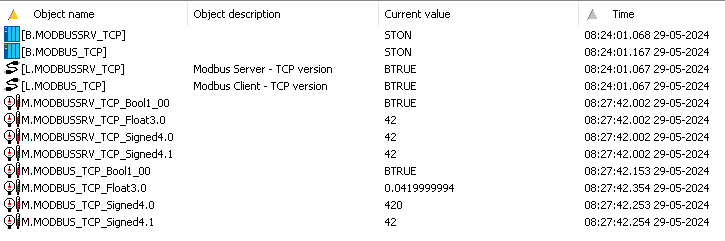
The attached ZIP contains the configuration of two lines and two stations with the MODBUS Client/MODBUS Server protocol that communicate via TCP (MODBUS Server listens on a TCP port 9999). Data written through one line is received through the other line. Four I/O tags are configured on each line (Float, with address 3.0, Signed with addresses 4.0 and 4.1, and Bool with address 1.0). MODBUS Server I/O tags values are controlled by the system second (Sec) and use linear conversion (Float is divided by 1000, Signed with address 4.0 is multiplied by 10). The value of the Bool I/O tag is controlled by the eval tag P.TrueFalse, which changes the value True/False every second.
|
| Info | ||||||
|---|---|---|---|---|---|---|
| ||||||
The attached ZIP contains the configuration of the line, station, and I/O tags for communication with an Emerson chromatograph that implements MODBUS DANIEL®.
|
| Info | ||
|---|---|---|
| ||
You can read blogs about the Modbus protocol
You can read blogs about the Modbus protocol |
...
- Ver. 1.0 - November 27th, 2006 - document creatingcreation.
- Ver. 1.1 - November 21st, 2007 - document update.
- Ver. 1.2 - April 24th, 2009 - document update.
- Ver. 1.3 - November 3rd, 2010 - document update.
- Ver. 1.4 - December 6th, 2010 - document update.
- Ver. 1.5 - September 5th, 2022 - document update (support for 8-byte values in the extended format).
- Ver. 1.6 - September 7th, 2022 - document update (added parameter "Dummy Request Mode").
- Ver. 1.7 - February 2, 2024 - document update (added destination column support).
...